

You’re reading your child’s IEP, and one line stops you: “Chunking as needed.” Is that helping your child reach the same goals as everyone else, or quietly lowering the bar? Honestly? Most of the time, the wording makes it impossible to tell.
💡 Pro-Tip: Bookmark this page so you can pull it up on your phone during your next IEP meeting!
First: Accommodation or Modification?
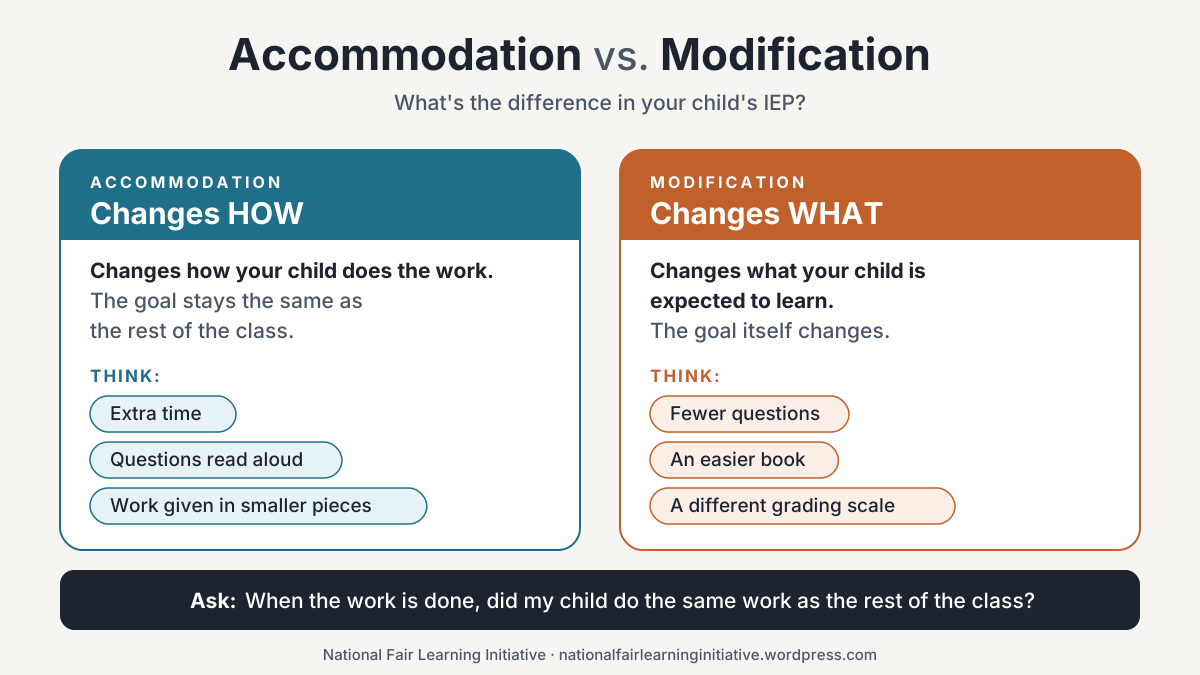
An accommodation changes how your child does the work. The goal stays the same as the rest of the class. Think extra time, questions read aloud, or work given in smaller pieces.
A modification changes what your child is expected to learn. Think fewer questions, an easier book, or a different grading scale.
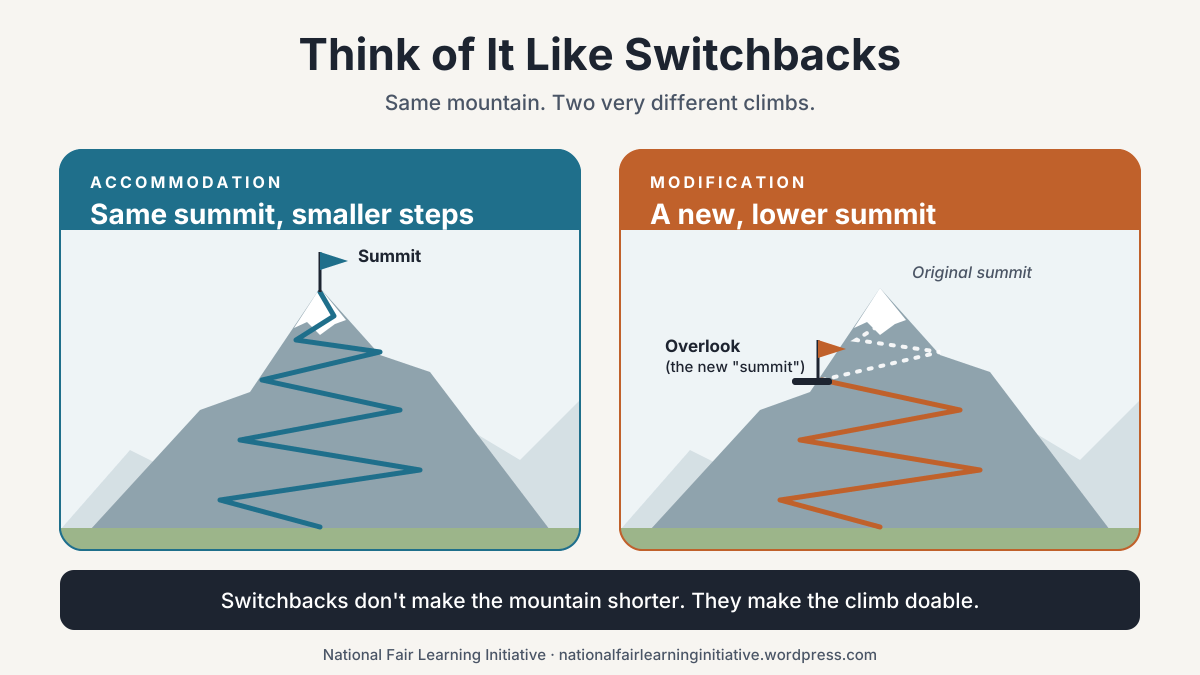
Picture a mountain trail with switchbacks. The zigzags break the climb into pieces you can manage, and you still reach the top. That’s an accommodation. A modification is stopping at the overlook halfway up and calling it the summit.
→ For any support, ask: “When the work is done, did my child do the same work as the rest of the class?” If yes, it’s an accommodation. If no, it’s a modification. We shouldn’t need a law degree to read our kids’ plans. But until IEPs are written in plain language, this one question does a lot of the work for us.
1. Vague Words Like “As Needed”
What it looks like: “Chunking of assignments as needed.” (Or “extra time as needed,” “breaks as needed.”)
The issue: Who decides when it’s needed? If two teachers could read that line and do two different things, it isn’t a plan. It’s a maybe.
Concrete Examples for Your Next Draft:
- “For assignments and tests with more than 10 questions or more than 3 steps, the teacher will give the work in sections of no more than 5 questions or 1 step at a time.”
- “[Name] will finish all sections. The teacher will check in after each section before giving the next one.”
- “Applies in math, English, science, and social studies.”
If you hear “the system only lets us pick from a list,” know that most IEP programs also have boxes for a description, how often, where, and how long. Federal law actually requires those details (34 CFR §300.320(a)(7)). Ask: “Which box can we put this in?”
2. Support Only “If the Student Asks”
What it looks like: “Student may request that assignments be broken into smaller parts.”
The issue: This puts the job on your child. If your child has trouble focusing, planning, or getting started, that same struggle can keep them from asking. And asking in front of classmates can feel embarrassing. Our kids shouldn’t have to raise their hand to get what’s already in their plan.
Concrete Examples for Your Next Draft:
- “The teacher will provide…” instead of “The student may request…”
- “Provided automatically for any assignment longer than one page.”
3. A Modification Dressed Up as an Accommodation
What it looks like: “Chunk and shorten assignments.” Or a 20-problem worksheet “chunked” by only giving the first 5 problems.
The issue: The support is listed as an accommodation, but your child is really doing less or easier work. That’s a modification, and nobody said so. Modifications aren’t the enemy. Surprises are.
| Accommodation (same work, smaller pieces) | Modification (less or different work) |
|---|---|
| 20 problems in 4 sets of 5; all 20 finished | Only the first 5 problems |
| Essay written in steps; graded like everyone else’s | One paragraph instead of five |
| Test given one page at a time | Half the questions, or easier ones |
Concrete Examples for Your Next Draft:
- “[Name] will complete the full assignment, given in sections.”
- If a modification is truly needed: “This is a modification. The team will explain in writing how it affects grades, state tests, and diploma options.”
4. Support That Only Counts in Some Places
What it looks like: The IEP says “chunk classwork.” Then the unit test comes home as a 6-page packet.
The issue: The support only follows your child into part of the day. Tests, homework, and big projects are often where kids need it most.
Concrete Examples for Your Next Draft:
- Tests: “Given one page at a time. Split into more than one sitting if longer than 30 minutes.”
- Homework: “Broken into marked sections with a suggested stopping point.”
- Big projects: “Broken into smaller steps with their own due dates, shared with [Name] and the parent at the start.”
5. Nobody Knows If It’s Working
What it looks like: Chunking has been in the IEP for three years, and nobody can tell you if it’s helping.
The issue: If nobody tracks it, nobody can tell whether to keep it, change it, or drop it. It just gets copied into next year’s IEP.
Concrete Examples for Your Next Draft:
- “The teacher will track how much of each assignment [Name] finishes, with and without chunking, and share it at each progress report.”
- Ask: “How do we know this is working? Can I see what you’ve tracked?”
What’s Your Experience?
Have you found an “accommodation” in your child’s IEP that turned out to be a modification? Or a teacher who wrote it exactly right?
Share your story in the comments. Another parent needs to hear it.
Coming Up in Part 2
Now that you can spot the red flags, Part 2 walks you through how to write a strong reason for each accommodation or modification, with examples you can copy, plus exactly what to do and say at your next IEP meeting.
You are not being difficult. You are doing your job.
Resources
- Wrightslaw — plain-language explanations of special education law
- Your state’s Parent Training and Information (PTI) Center — find yours at parentcenterhub.org
- COPAA (Council of Parent Attorneys and Advocates)
Sources