

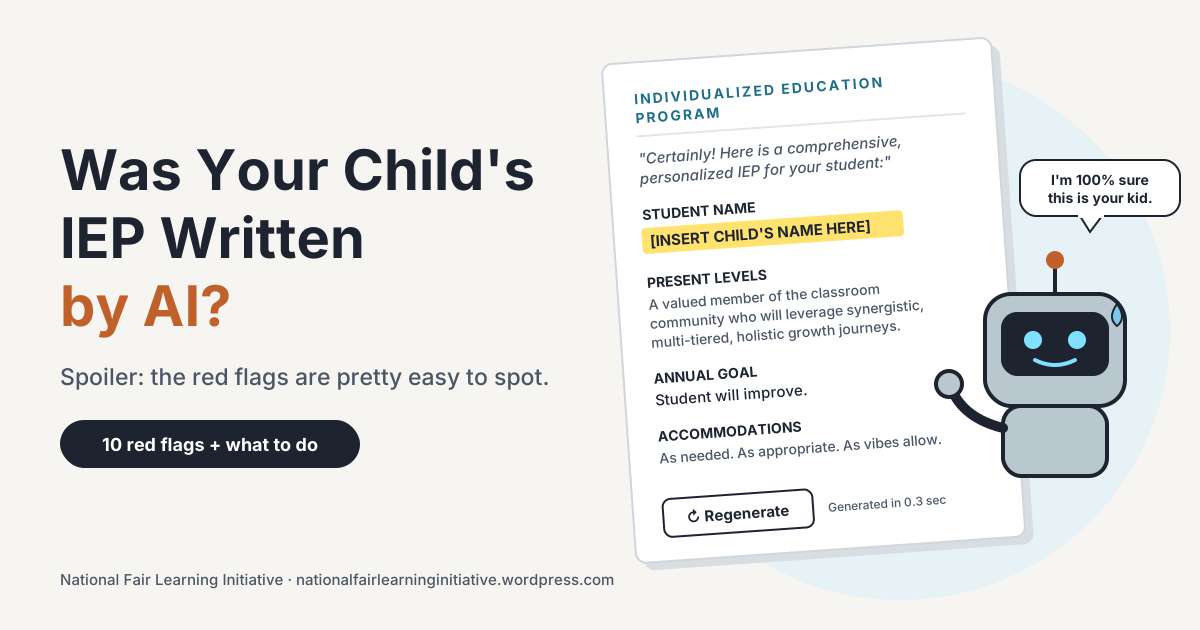
Parents are starting to ask a new question: Was my child’s IEP written by AI? (Like the image above ; )
If you’re asking it, I want you to know two things. First, you’re not being paranoid. Most special education teachers now use AI somewhere in the IEP process. Second, the question underneath it matters even more: Did anyone make sure this plan is actually about my child?
You don’t need to prove how a plan was written to know whether it was written for your child. Here are the red flags I’d look for, with examples of what they look like on the page and what they should look like instead.
A quick note before we start: there’s no reliable way to prove a document was written by AI. AI detectors get it wrong all the time. So don’t spend your energy playing detective about the tool. Spend it on the plan. Every red flag below matters whether it came from a chatbot, a drop-down menu, or a rushed Sunday night.
Red Flag #1: Present Levels With No Real Data
The present levels section is the foundation of the whole IEP. Every goal and service is supposed to grow out of it. When it’s built on vague statements instead of evidence, everything stacked on top of it is guesswork.
What it looks like: “Student demonstrates difficulty with reading comprehension and would benefit from continued support in this area.”
What it should look like: “On a fall fluency check, [Name] read 62 words correct per minute on a 4th-grade passage (the grade-level benchmark is about 94). He answered 3 of 8 comprehension questions correctly, missing mostly inference questions. His accuracy improves when a passage is read aloud to him first.”
Notice the difference. The second one has numbers, dates, and something only a person who has watched your child would know.
Red Flag #2: Details That Don’t Match Your Child
This is the one that makes your stomach drop. You’re reading along, and suddenly the IEP is describing someone else.
What it looks like:
- “She enjoys working with peers in small groups” about a son who shuts down in group work.
- “Student will prepare for the transition to middle school” in a third grader’s plan.
- A diagnosis your child doesn’t have, a strength you’ve never seen, or another child’s name left in by mistake.
Errors like these tell you something important: nobody read this draft closely with your child in mind. If the small details are wrong, look hard at the big ones.
Red Flag #3: Goals That Could Fit Any Student
A goal should be specific enough that you could pick your child out of a crowd by reading it. If you could hand it to any kid in the building, it’s not individualized.
What it looks like: “Student will improve reading fluency.” Or “Student will demonstrate improved self-regulation skills.”
What it should look like: “By the annual review, when given a 4th-grade passage, [Name] will read 90 words correct per minute with 95% accuracy in 3 of 4 weekly checks, measured by his reading teacher.”
→ Look for four things in every goal: where your child is now (baseline), where they should be (target), by when, and how progress will be measured.
Red Flag #4: Goals That Don’t Connect to the Needs
Read the present levels, then read the goals. They should line up like a question and its answer.
What it looks like: The present levels say “He avoids written tasks and produces one to two sentences in a 20-minute writing period.” Then the goals cover math computation and “will follow classroom expectations with fewer than two reminders.” Nothing about writing at all.
I’ve lived this one. Jack’s old behavior plan gave him sticker charts for “complying” with writing tasks. It never once addressed why writing was so hard for him. When the goals skip the actual need and target the behavior around it instead, ask why.
Red Flag #5: Services That Can’t Deliver the Goals
Goals are promises. Services are how the school keeps them. If the services page doesn’t give your child enough of the right help to reach the goals, the plan is set up to fail.
What it looks like: A written expression goal and a handwriting goal, but the services page lists “Specialized instruction: 30 minutes per week, general education setting” and no occupational therapy. Or services listed as “as needed” with no minutes at all.
What it should look like: Services that match the size of the need, with the minutes, how often, who provides them, and where. For example: specialized writing instruction with the special education teacher, 45 minutes, four times a week, plus occupational therapy, 30 minutes a week.
A vague services page is also hard to hold anyone to later. If minutes aren’t written down, you can’t tell whether they were delivered.
Red Flag #6: The Same Accommodations You’ve Seen Everywhere
There’s nothing wrong with common accommodations. The problem is a list that was clearly chosen from a menu instead of from your child.
What it looks like: “Extended time. Preferential seating. Frequent breaks. Check for understanding.” That’s it. The same four lines you’d find on a list of accommodations online.
What it should look like: Accommodations tied to how your child actually learns, each with a reason that matches your child. For a child with dysgraphia, that might be:
- Speech-to-text for written assignments longer than three sentences. Reason: Handwriting takes so much effort that his ideas get lost before they reach the page.
- May answer test questions orally or by typing. Reason: A test should measure what he knows, not how well he can form letters.
- Receives a printed copy of class notes. Reason: Copying from the board takes him far longer than his classmates, so he misses the lesson while he writes.
→ Every accommodation should come with a “why” that describes your child. If the reason could apply to any student, or there’s no reason at all, ask the team how it was chosen.
When Jack finally got the right support, his accommodations included the option to show what he knew out loud or by typing. It was one line in his plan, and it was written for him.
Red Flag #7: Polished Language That Says Very Little
This is the one people most often notice in AI writing. It sounds impressive. It flows. And when you finish the paragraph, you can’t say what it actually means.
What it looks like: “[Name] is a valued member of the classroom community who will benefit from a comprehensive, multi-tiered approach leveraging evidence-based strategies to foster growth across academic and functional domains.”
Ask yourself: what will someone actually do differently for my child on a Tuesday morning because of this sentence? If you can’t answer that, it’s filler. Watch for the same smooth phrases repeating from one section to the next, too.
→ A real IEP is often a little clunky. It’s full of specifics, numbers, and names. Smooth isn’t the same as good.
Red Flag #8: Vague or Made-Up Research
IDEA expects services to be based on peer-reviewed research to the extent practicable. That’s a good thing. But AI tools are known to invent sources or misstate what a study found, and a plan can name-drop “research” without pointing to anything real.
What it looks like: “Instruction will utilize research-based strategies shown to improve outcomes for students with learning differences (Johnson & Lee, 2019).” When you ask which strategies, or look up the study, nobody can find it.
What it should look like: A named approach you can look up and ask about, such as “structured literacy instruction using an Orton-Gillingham–based program,” with who will provide it and how often.
→ It’s always fair to ask: “Which program, specifically? Can you send me information about it?”
Red Flag #9: Last Year’s Goals, Recycled
Put this year’s draft next to last year’s IEP. If the goals are the same, or nearly the same, something is wrong. Either your child didn’t make progress and the plan needs to change, or they did and the goals should move forward.
What it looks like: “[Name] will write a complete paragraph with a topic sentence and two supporting details” appearing for the third year in a row, word for word.
This isn’t a small thing. The family in Endrew F., the 2017 Supreme Court case that defined what IDEA requires, argued that their son’s progress had stalled because his IEP kept carrying over the same basic goals year after year (Boardman Clark summary). The Court ruled that an IEP has to be built for progress that fits the child’s circumstances.
Red Flag #10: Nothing You Said Made It In
This may be the most important red flag of all. Under IDEA, you are a full member of the IEP team. Your observations count.
What it looks like: At the last meeting, you explained that your daughter melts down after lunch, that she reads far above grade level but can’t write a sentence by hand, and that she’s been asking to stay home on Mondays. The new draft mentions none of it.
When your input disappears, it often means the draft was finished before anyone sat down with what you shared. Nobody once asked Jack why he was refusing to write. Make sure someone asks about your child.
What You Can (and Should) Do
If you’re seeing these red flags, you are not stuck with this draft. Here’s what you can do, starting today.
Step 1: Don’t sign anything yet. You’re allowed to take time to review a draft before agreeing to it. The rules on drafts and signatures vary by state, so check the procedural safeguards notice your school is required to give you.
Step 2: Mark up the draft. Go through it with a pen. Circle every detail that’s wrong, every present level without data, every goal you can’t measure, and every need that has no goal or service attached.
Step 3: Put it next to last year’s IEP. Compare the goals, services, and accommodations side by side. Note what changed, what didn’t, and whether the changes are backed by data.
Step 4: Gather your own evidence. Report cards, outside evaluations, therapist notes, work samples, and your own notes about what helps and what doesn’t. When I finally got Jack an independent evaluation, the evaluator’s report was 52 pages. The school’s had been six. Detail matters.
Step 5: Ask how the plan was put together. Go in curious, not accusatory. Most teachers are doing their best under impossible caseloads. Good questions to ask:
- What data supports the present levels? Can I see the assessments and work samples?
- Which need in the present levels does each goal address?
- How will progress on each goal be measured, and how often will I get updates?
- Did you use any AI or software tools to draft this IEP? Is that tool approved by the district, and what information about my child went into it?
→ Sample language: “I appreciate the work that went into this draft. Before I agree to it, I’d like to understand how each goal connects to [Name]’s present levels, and what data we used. Some of this doesn’t sound like [Name] yet, and I want to make sure we get it right.”
Use your child’s name, not “the student.” You’d be surprised how much it changes the room to hear it out loud.
Step 6: Propose specific changes. Instead of “this goal is too vague,” bring the rewrite: a baseline, a target, a timeframe, and how it will be measured. Use the “what it should look like” examples above as a model.
Step 7: Put it in writing. Verbal conversations don’t create paper trails. After the meeting, send a short email summarizing what you asked for and what the team agreed to.
Step 8: Raise privacy concerns separately. If you believe your child’s information was entered into an unapproved AI tool, ask the district in writing what was shared and how it’s being protected.
Step 9: Get support if things stall. Every state has a federally funded Parent Training and Information Center that helps families with IEPs for free. An advocate or special education attorney can help, too. And if you can’t reach agreement, IDEA gives you formal options like mediation, state complaints, and due process.
Most of the time, it never gets that far. A clear, specific request is often enough to turn a generic draft into a real plan.
You Know Your Child. That’s the One Thing No Software Can Supply
You may never know for sure whether AI helped write your child’s IEP. And honestly, you don’t need to.
What you can know is whether the plan describes your child accurately. Whether the goals fit them. Whether what you told the team actually made it onto the page.
If it does, the tool behind it matters a lot less. If it doesn’t, ask why. Then ask again, in writing.
You are not being difficult. You are doing your job.
Resources
- Wrightslaw — plain-language explanations of special education law
- Your state’s Parent Training and Information (PTI) Center — find yours at parentcenterhub.org
- COPAA (Council of Parent Attorneys and Advocates)
- IEPNotes and the National Fair Learning Initiative — tools, advocacy, and community for families navigating special education
Sources